
Google Launches Arabic Transliteration Tool, Takes On Yamli
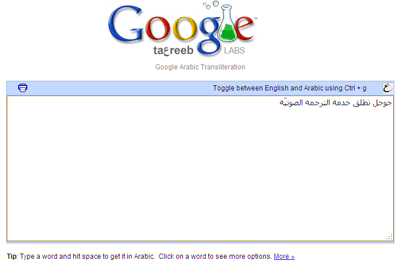
 Google recently launched a new Arabic transliteration tool, that allows users to use their Latin keyboards to type in Arabic text. This move puts them in direct competition with Yamli, a small startup that has proven very popular and generated great feedback; simulating a modern day tech reenactment of David vs. Goliath.
This isn’t the first time Google works on transliteration; they actually launched transliteration services from English to various Indian languages like Hindi, Kannada, Malayalam, Tamil, and Telugu on Blogger and through Google Talk bots over the past year.
Now with Google’s push in the Arab world, they’ve gone on and launched ‘Google Ta3reeb’ (Google Arabization). The new tool was one of the services visible at the Google booth at Gitex Technology Week in Dubai.
From my initial usage of the tool, and comparing it to Yamli; Yamli stills seems to maintain the advantage, by being faster and offering more relevant transliterations and word suggestions. But I expect the Google tool will get better with time, as more people use it, and its inner workings optimised.
According to an anonymous tip that was picked up by TechCrunch, actually searching for ‘Yamli’ or ‘Yamli.com’ on Google’s Arabic versions like (Google.ae or Google.com.sa), users get a search results page that prominently displays ads for Google’s competing service alongside the search results, which suggests that Google is using Yamli’s name to target ads for their new service.
I’ve contacted both Yamli and Google for their comments on this story and should be following up with their responses pretty soon.
Update 1: Google has gone on and retracted the above mentioned ads.
Update 2: Responding to my enquiry about the story, Yamli co-founder Habib Haddad said “We are happy to see Google serving the Arabic web and we welcome healthy competition. Our primary focus as a young Arabic startup is and will remain on innovations for the Arabic user for whom we think we can continue to make significant contributions.”
Looks like google has retracted the offending ads
I guess, this is one of those rare occasions where David prevails over the goliath!
Looks like google has retracted the offending ads
I guess, this is one of those rare occasions where David prevails over the goliath!
This is a move that has to be taken seriously by Yamli. This can be the end of a very smart and creative idea, and we should not allow this to happen. I think that all the users should stick with the Yamli and support this small business.
Although I usually love competition because it produces better products and services, yet I don’t like the idea that software giants are eating up the whole market share and pushing young entrepreneurs out !
This is a move that has to be taken seriously by Yamli. This can be the end of a very smart and creative idea, and we should not allow this to happen. I think that all the users should stick with the Yamli and support this small business.
Although I usually love competition because it produces better products and services, yet I don’t like the idea that software giants are eating up the whole market share and pushing young entrepreneurs out !
well…its actually very shocking to know that a huge firm like Google Inc can do such thing to a startup firm like Yamli…we all know that having Yamli services as API or as open source dose not mean its free to be adopted.
so, I guess it somehow effecting the positive image of Google Inc but it also highlights the importance of Yamli services for Arab internet users, web developer and blogger worldwide.
well…its actually very shocking to know that a huge firm like Google Inc can do such thing to a startup firm like Yamli…we all know that having Yamli services as API or as open source dose not mean its free to be adopted.
so, I guess it somehow effecting the positive image of Google Inc but it also highlights the importance of Yamli services for Arab internet users, web developer and blogger worldwide.
So, what is the next move for Yamli? Google card was lost, I think they have to walkthrough other options.
So, what is the next move for Yamli? Google card was lost, I think they have to walkthrough other options.
I’m personally proud that Yamli was able to ruffle a few feathers of a big power house of a company. Only means that you guys are on the right track and more so now, that you have something special that they can’t match.
Stay focused, ignore the noise and keep delivering great technology.
I’m personally proud that Yamli was able to ruffle a few feathers of a big power house of a company. Only means that you guys are on the right track and more so now, that you have something special that they can’t match.
Stay focused, ignore the noise and keep delivering great technology.
Yamli web services are indeed very important for Arab Internet users, web developer and blogger worldwide. Again another small startup company survives.
Yamli does deliver more relevant transliterations.
Great article, Mohamed!
Yamli web services are indeed very important for Arab Internet users, web developer and blogger worldwide. Again another small startup company survives.
Yamli does deliver more relevant transliterations.
Great article, Mohamed!
I certainly will go with Google, business wise, Google is smart company, stable, continues development, great support and i don’t think they will fail, on the other hand, i have tested both, and i found Google results more accurate, and the processing speed is almost half of yamli.
I certainly will go with Google, business wise, Google is smart company, stable, continues development, great support and i don’t think they will fail, on the other hand, i have tested both, and i found Google results more accurate, and the processing speed is almost half of yamli.
@TRIPLEM
The concept behind the open source software is a continues development, share, copyleft and not the monopoly, thats why they call it OSS, simple example, you can take the linux and develop it, no body will prevent you from doing that, and at the end the better is the winner, and not the first.
@TRIPLEM
The concept behind the open source software is a continues development, share, copyleft and not the monopoly, thats why they call it OSS, simple example, you can take the linux and develop it, no body will prevent you from doing that, and at the end the better is the winner, and not the first.
@Muhannad: the argument of using Google because they are a bigger and more stable company goes against the same spirit of entrepreneurship and innovation that this blog is trying to promote and that we lack in the Arab world.
I chose to go with the better product and it seems everyone agrees that Yamli does a better job today then Google … It seems also everyone agrees that trying to kick out the little guy by using shady techniques was a pretty bad move from Google …
I regularly need to type Arabic, I played with both and I am sticking with Yamli, and I also join my voice with others in supporting an Arabic startup against an established giant and hope you will do the same…
@Muhannad: the argument of using Google because they are a bigger and more stable company goes against the same spirit of entrepreneurship and innovation that this blog is trying to promote and that we lack in the Arab world.
I chose to go with the better product and it seems everyone agrees that Yamli does a better job today then Google … It seems also everyone agrees that trying to kick out the little guy by using shady techniques was a pretty bad move from Google …
I regularly need to type Arabic, I played with both and I am sticking with Yamli, and I also join my voice with others in supporting an Arabic startup against an established giant and hope you will do the same…
@Dzm
Glad to hear your point of view, but let me clarify a point regarding Spirit of entrepreneurship and innovation by the below example:
Let’s take an example the linux OS is open source, and based on it, you can find Red Hat’s and Sun Microsystems, Canonical Ltd., Mandriva, Microsoft, Novell, Oracle Corporation, IBM and Xandros, all of them have their own developed version of linux, and nop body create any problem because they really understand what is the OSS.
We cant just say this application is open source, and when someone develop on it, we say this is against entrepreneurship and innovation, otherwise yamli shouldn’t say this is OSS, and they should go and register it as a patent.
On the other hand yamli comes up with that great idea, which is really great, and nobody can say a word against it.
@Dzm
Glad to hear your point of view, but let me clarify a point regarding Spirit of entrepreneurship and innovation by the below example:
Let’s take an example the linux OS is open source, and based on it, you can find Red Hat’s and Sun Microsystems, Canonical Ltd., Mandriva, Microsoft, Novell, Oracle Corporation, IBM and Xandros, all of them have their own developed version of linux, and nop body create any problem because they really understand what is the OSS.
We cant just say this application is open source, and when someone develop on it, we say this is against entrepreneurship and innovation, otherwise yamli shouldn’t say this is OSS, and they should go and register it as a patent.
On the other hand yamli comes up with that great idea, which is really great, and nobody can say a word against it.